Cjenik.app
2025 · hospitality digital menu and publishing SaaS · digital product
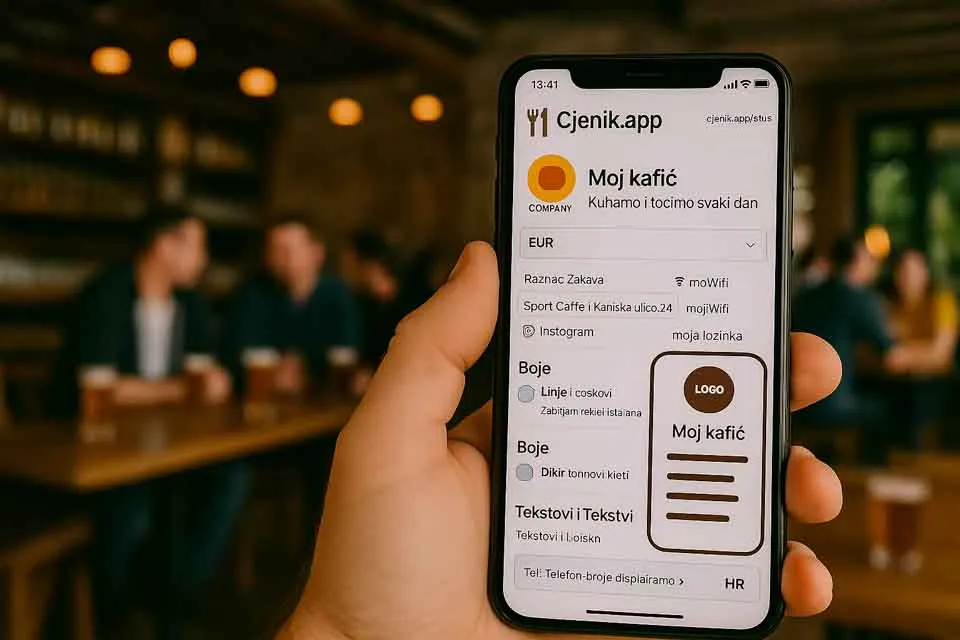
Cjenik.app is a Croatian hospitality SaaS for creating, publishing, and maintaining multilingual digital menus.
This project credentials: Product & software development
Notes from the producer
I built Cjenik.app almost entirely myself, and it started from the least glamorous problem in hospitality: a cafe changes a price, and updating the menu everywhere becomes a nuisance. The first real commit window is 11 February 2025; most of the product took shape across 2025, followed by a long hardening push in spring 2026. I kept the dependency list short on purpose — Cloudflare Images for media, Google Translate for languages, Font Awesome for icons — so the thing stays cheap to run and hard to break.
I will be straight about the state of it. The dashboard, the multilingual public menus, the QR and short-link delivery, the tier gating and the pricing (free, 2 EUR a month, or 100 EUR once) are all real and shipped. What is not fully closed is the money plumbing: payment verification is still partly manual, and I do not have a clean post-launch reconciliation to point at. This is a product I made, not a case study I dressed up.
- Matija Radeljak
The story
Cjenik.app began on 11 February 2025 out of the least glamorous problem in hospitality: menus change constantly, while the traditional way of updating them is slow and fragile. Matija Radeljak built it inside Aning Film as a single-developer product — a dashboard-to-public-menu system for cafes, bars, restaurants and small hotels, where an operator edits prices in the back office and a guest reaches the current, multilingual menu through a short link or a QR code.
Through 2025 it went from scaffolding to a recognizable product. By June 2025 dynamic menu templates, a login flow and publishing had turned the codebase into an operator dashboard; July 2025 was a high-throughput UX cycle, with reordering, the onboarding tutorial, the publish popup and self-print behaviour reworked in short loops — reverts and rebuilds used as design pressure rather than accidents.
2026 was hardening, not invention. A features manifest formalized on 6 April mapped thirteen operational domains, from authentication, moderation and onboarding to verification, tier gating, Cloudflare Images handling and public menu delivery. Company metadata on 9 April bound the product to Aning Film d.o.o. and set three plans — a free tier, premium at 2 EUR monthly or 20 EUR yearly, and a 100 EUR one-time lifetime tier — with a pricing and VAT pass on 16 April. Late-cycle work tightened a desktop DOM contract on 20 April and generated a codified design system of tokens, components and motion rules on 30 April; a public sitemap snapshot on 3 May listed the live homepage and legal routes.
Translation runs through Google Translate, media through Cloudflare Images, icons through Font Awesome — a deliberately thin dependency surface for a product meant to run cheaply and stay hard to break. Delivery included its own communication material too: desktop and mobile promo videos, not just a working backend.
For the studio, Cjenik.app proves product development end to end — a working SaaS designed, built, priced and published by one person, from the database to the QR code in front of a guest. It is also honest about what is unfinished: payment verification is still partly manual, and full post-launch financial reconciliation remained open beyond April 2026. There is no third-party press; the footprint is entirely product-owned.
Milestones
- 2025-02-11 — Development begins; project baseline established
- 2025-06 — Dynamic menu templates, login and publishing make it a dashboard product
- 2025-07 — High-throughput UX cycle reworks reordering, onboarding, publish and self-print
- 2026-03 — Feature flags, verification and subscription logic for MVP readiness
- 2026-04-06 — Features manifest v1.0 maps thirteen operational domains
- 2026-04-09 — Legal identity and three-tier EUR pricing set via company metadata
- 2026-04-30 — Codified design system generated (tokens, components, motion rules)
- 2026-05-03 — Public sitemap lists live homepage and legal routes
Outcomes
- Shipped product — Dashboard editing, public menu delivery, moderation controls and tier-based feature gating
- Subscription model — Three tiers: free, premium (2 EUR monthly / 20 EUR yearly), lifetime (100 EUR one-time)
- Design system — Codified tokens, component specifications and motion/elevation rules (30 April 2026)
- Launch communication — Desktop and mobile promo videos produced for public product presentation
Credits
- Matija Radeljak — Lead developer
- Aning Film d.o.o. — Operator / legal entity
- Cloudflare Images — Media infrastructure
- Google Translate — Translation service
- Font Awesome (Fonticons, Inc.) — Icon framework
Press & links
- https://cjenik.app/
- https://cjenik.app/blog/
- https://aningfilm.hr/about-us/
- https://eave.org/network/matijar