jabuka
2013 · feature-length documentary · film project
Feature documentary tracing GK Jabuka's 1968 roots, scene identity, and intergenerational Zagreb nightlife continuity.
Notes from the producer
I wanted Jabuka because it is one of the few places in Zagreb where the story is genuinely continuous — the club opened in 1968 and simply never stopped. So I built it the way I build things: write the script, map the people, get the paperwork right. HAVC backed the script development, Vedrana Pribacic and I drafted it twice, we recorded interviews, cut a Croatian and an English trailer, and got GK Jabuka to sign as a co-producer at 10 percent. On paper it was a real film.
What I will not dress up is the ending: it never got shot to completion. The budget climbed toward 700,000 kn, the roadmap ran to 2020, and the trail goes quiet after the 2015 draft. I logged 35,000 kn of actual development spend and a written, financed, co-produced package — and then it stalled. I am proud of the development work and honest about the fact that the film does not exist. Both of those are true at once.
- Matija Radeljak
The story
Jabuka was meant to be a feature documentary about one room that refused to change while the city around it did. Its subject, Glazbeni klub Jabuka, opened on Jabukovac in Zagreb in 1968 and has run continuously ever since as the city's home for alternative and rock music. Matija Radeljak and Aning Film approached it as a film about continuity under pressure: the same bar, the same doorway, five decades of people passing through, and a country that changed political weather at least three times underneath them.
The development was disciplined and it left a paper trail. Script drafts moved between Radeljak and co-writer Vedrana Pribacic across four days in July 2013. That September the team assembled an English-language package for ArchiDoc 2013. By April 2014 the project was formalised as a screenplay-development application to the Hrvatski audiovizualni centar (HAVC) — author's concept, synopsis, treatment and a producer's letter — with a proofed update issued the following month. In June 2014 the development co-financing was secured and a screenwriting contract signed at a fixed fee of 25,000 kn. A second, revised feature screenplay was finished in January 2015.
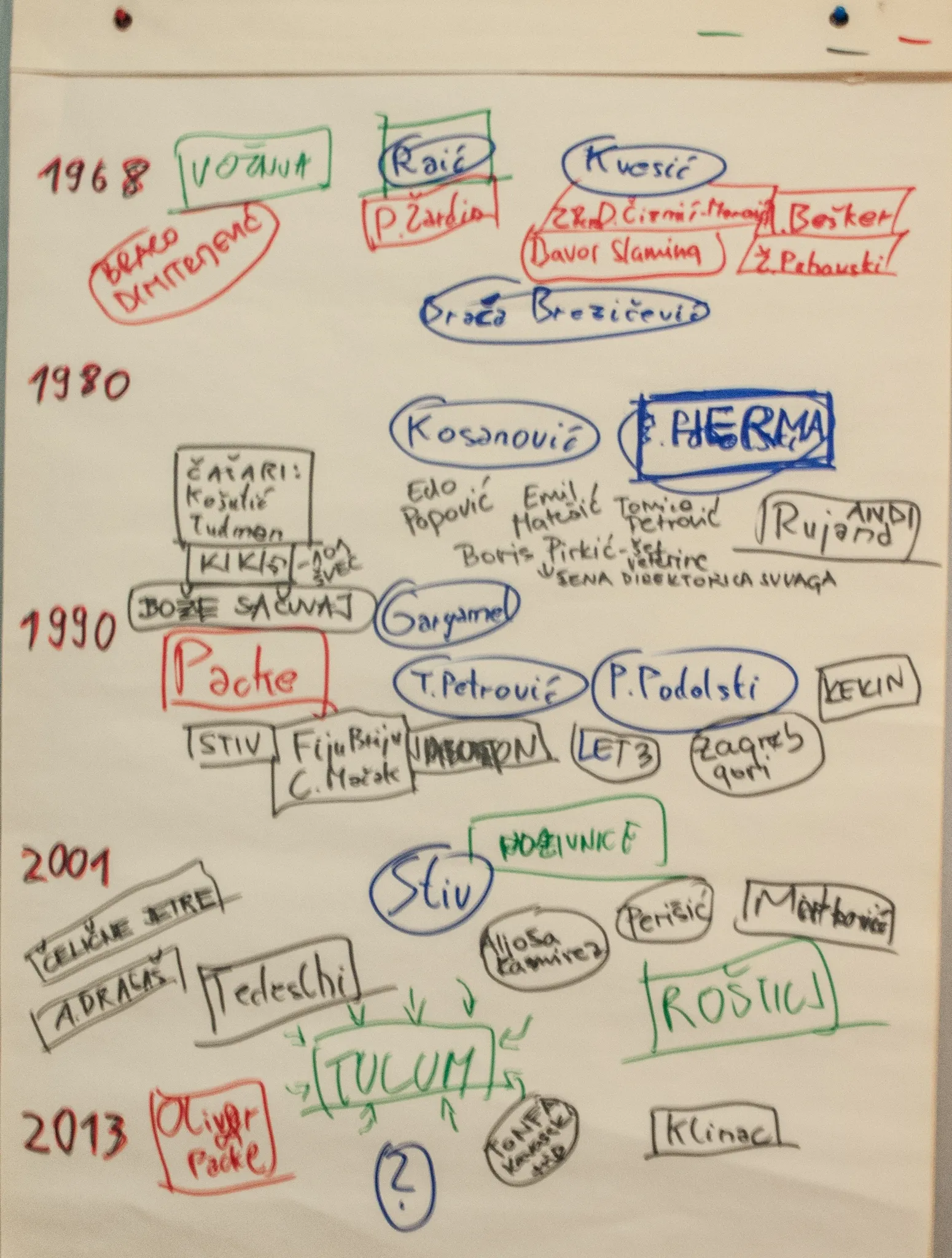
The method was to map the club as a cast rather than a monument. The character list ran from the founders Pero Kvesic and Nikola Raic through the people who kept it running day to day — manager Marin Stiv Viduka, barman and promoter Marijo Stojanovic — out to the regulars and voices who located Jabuka inside a wider cultural circuit: businessman Emil Tedeschi, musicians Goran Bare and Mile Kekin, journalists and DJs across three generations. The club's own visual identity did some of the work: the red apple logo, and the "45 godina" poster exhibition mounted at the Archaeological Museum in Zagreb in December 2013. On the film side, the team recorded interviews — including a long winter-2014 session with Stiv — cut Croatian and English trailers, and put a teaser on Vimeo, with development fieldwork travel logged through 2014.
The money tells the honest version. Early planning sat near 500,000 kn in 2013; the HAVC packet a year later raised the estimate to 700,000 HRK across a multi-year roadmap that ran development in 2014, pre-production in 2015, and production and distribution out to 2020. GK Jabuka itself signed on as co-producer with a 10 percent participation share. The actual development spend, as filed in the February 2015 report, was 35,000 kn — honorarium, legal work, camera testing in the club, and travel.
And then it stopped. The roadmap through 2020 was never executed; the film was never shot to completion, and the record simply goes quiet after the 2015 draft. What Jabuka proves is not a finished film but a service done properly: development and co-production structuring — taking a beloved but unwieldy subject and turning it into a written, contracted, publicly co-financed package, with a real co-producer signed and a script twice drafted. The film did not get made. The groundwork for making it did.
Milestones
- 2013-07 — First screenplay drafts (Radeljak with Vedrana Pribacic)
- 2013-09 — English-language ArchiDoc 2013 development package assembled
- 2013-12 — "45 godina GK Jabuka" poster exhibition, Archaeological Museum, Zagreb
- 2014-04 — HAVC screenplay-development application submitted
- 2014-06 — HAVC development co-financing secured; screenwriting contract signed
- 2015-01 — Second feature-documentary screenplay draft completed
- 2015-02 — Development financial report filed (35,000 kn spent)
Outcomes
- Screenplay developed — Two feature-documentary screenplay drafts (2013-2015), with HAVC development co-financing secured
- Trailers produced — Croatian and English trailers cut in 2014; teaser published on Vimeo
- Interviews recorded — Character interviews including a winter-2014 session with club manager Marin Stiv Viduka
- Co-production structured — GK Jabuka contracted as co-producer at 10% of project value
- Not completed — Project stalled in development; the feature was never shot to completion
Credits
- Matija Radeljak — Director, screenwriter, producer
- Vedrana Pribacic — Screenwriter
- Ana Djordic — Screenwriter
- Bojan Kanjera — Producer
- Aning Film — Production company
- GK Jabuka — Co-producer