Magi
2015 · biographical music road drama in development · feature fiction film
Feature film project on Margita developed through intensive regional and European co-production labs.
Notes from the producer
Magi is the one I still think about. Marijana Verhoef wrote it and would have directed it, and the subject - Magi Stefanović and the world of Ekatarina Velika - deserved a real film. We did the development properly: a treatment, an operational plan, budgets at three scales, and applications to HAVC, RE-ACT, CineLink and the Holland Film Meeting, all inside a few months of 2015.
What I cannot show you is a financed production. We got the package into the right rooms and we shot a test with the Wajda studio, but the financing never closed and the co-production was never signed. I would rather say that plainly than dress it up. What sits in the archive is a development effort that ran out of road, not a premiere.
- Matija Radeljak
The story
Magi is a feature-film project that Aning Film developed between 2014 and 2016 around Margita Stefanović - Magi - the keyboardist of the Belgrade rock band Ekatarina Velika, with the band's singer Milan Mladenović as co-protagonist. Written and directed by the Berlin-based Marijana Verhoef and produced by Matija Radeljak, it was conceived as a biographical music road drama: one musician's story used to read a wider regional history of rupture and survival.
The work that exists is development work, and there is a lot of it. From a treatment dated December 2014 and a scheduled operational plan, the project ran several funding and market tracks in parallel through 2015. It was registered for Sarajevo's CineLink co-production market in January, its RE-ACT co-development application was finalised on 16 April, and a Croatian Audiovisual Centre (HAVC) development application followed on 28 April, with a producer's statement dated 4 May. The package also went out to the Holland Film Meeting. A December 2014 Rolling Stone feature sat inside it as press support.
The financing was drawn at three scales. A development budget of 289.261,66 HRK covered writing and preparation; an international financing estimate reached 880.000 EUR; and the CineLink package modelled a full 4.120.000 EUR production, with staged production and post-production windows running to 2020. The targeted funders matched that ambition - 55.000 EUR from HAVC, 20.000 EUR from RE-ACT, 20.000 EUR from Eurimages. RE-ACT itself was brand new that year, a co-development fund shared by Croatia, Slovenia and Friuli Venezia Giulia and tied to TorinoFilmLab, which is exactly where a project like this was meant to grow.
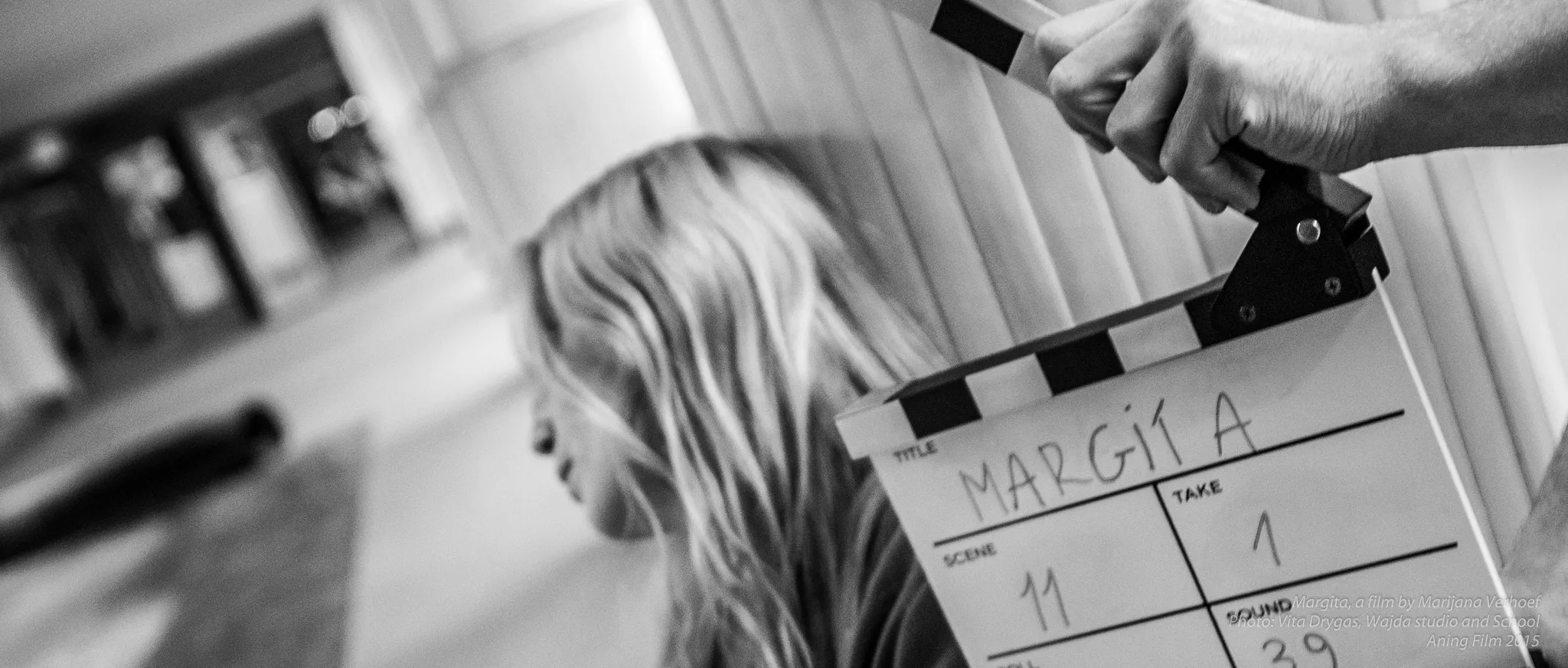
Some of it reached a camera. Black-and-white set photographs from 2015, credited to the Wajda studio in Warsaw and Aning Film, show a crew, a clapperboard reading MARGIT, and an actress in frame - a test, not a financed shoot. That is where the documented arc stops. No final financing close is recorded after the 2017-2020 plan, no co-production agreement with the named Serbian or Slovenian partners was signed, and there is no evidence of principal photography under the intended structure.
What Magi proves is not a finished film but a capacity: taking one script and packaging it coherently, at the same time, for four different rooms - a national fund, a regional co-development scheme, a co-production market, and an international meeting - each with its own budget logic and its own idea of what the film should be. Most of that labour is invisible when a project does not close. This one did not, and the files are the honest record of how far it got.
Milestones
- 2014-10 — Operational plan and treatment drafting enter a scheduled development phase
- 2015-01 — CineLink co-production market submission registered (Sarajevo Film Festival)
- 2015-04 — RE-ACT co-development application finalised (16 April)
- 2015-04 — HAVC development application filed (28 April)
- 2015-05 — Producer's statement formalised (4 May)
Outcomes
- RE-ACT 2015 package submitted — Application assembled and filed with treatment, synopsis and motivation materials on 16 April 2015
- HAVC development application filed — Croatian Audiovisual Centre development documentation prepared and submitted on 28 April 2015
- Multi-stage production budget formalised — Development, production and post-production plans mapped across three budget scales through 2020
- Development-market positioning — Project carried into CineLink, RE-ACT and the Holland Film Meeting as a coherent co-production package
Credits
- Marijana Verhoef — Writer-director
- Matija Radeljak — Producer
- Aning Film d.o.o. — Production company
- Margita Stefanović — Biographical subject
- Milan Mladenović — Co-protagonist
Press & links
- https://www.midpoint-institute.eu/en/person/marijana-0ZotFW
- https://www.torinofilmlab.it/people/720125/Marijana-Verhoef
- https://www.cinelinkindustrydays.com/
- https://www.imdb.com/name/nm0825048/