Sredstva
2026 · Searchable bilingual registry of Croatian audiovisual public funding, every amount linked to its HAVC source document · Author, developer, publisher
An open, source-linked registry that turns eighteen years of HAVC funding decisions from loose PDFs into searchable public data.
Notes from the producer
I have been on the applicant side of HAVC decisions since my first film, and I always knew the numbers were public. What I could not do was read them: a producer's history, a programme's total over a decade, a film's path from script development to distribution — all of it was in the PDFs and none of it could be searched. Sredstva is my answer to that, built with Aning Film's own money in 2026 and published on 17 May with the full dataset and the code. I am a producer who writes software, and this is the plainest demonstration I have of why the two belong together: computing as standardisation and transparency, which fragile independent budgets depend on more than anyone admits.
Two things I refuse to do. I will not let a convenient interface sever a number from the document it came from — every amount in the registry opens the PDF it was read from, and when a record is corrected the original value stays in the log. And I will not republish personal data just because it sits in a public PDF: the auxiliary documents that pair names with OIBs and phone numbers ship without their text, identifiers are masked everywhere else, and a test blocks the release if any get back in. The registry says only what HAVC already published, in a form that can finally be used.
I also want to be straight about what it is. Every record was machine-extracted and carries a public verification status; for anything with consequences, open the source PDF. The 2027 application asks HAVC for 7,500 euros to turn this into twelve dated editions, a schema and a tool anyone in a public institution can use to publish results as open data. If the Centre one day publishes structured results itself and Sredstva becomes an archive, that is the outcome I am working towards.
- Matija Radeljak
The story
Sredstva started from a producer's irritation. The Croatian Audiovisual Centre publishes every funding decision it makes — results tables, jury narratives, individual rulings — but as loose PDFs on its website, so nobody can search a recipient across years, total a programme over a decade or follow a film from script development to distribution without opening hundreds of files by hand. Matija Radeljak had spent years on the applicant side of those decisions. On 21 January 2026 he ran two deterministic Python scripts over roughly 1,100 of those PDFs and got a 2.1 MB table of titles, amounts and years: structured, cheap, and missing everything that mattered — the jury reasoning, the people, and the identity of a project across rounds.
The real build was a 48-hour sprint on 16 and 17 May 2026. A classifier routed each PDF before any paid extraction; a fleet of subagents then read results tables and narratives under a nine-kilobyte instruction file with ten rules — capture every row, preserve Croatian diacritics, read 19.000,00 as nineteen thousand, infer kuna or euro from the year. A chain of audited correction passes followed, each leaving a checked-in receipt: 139 bogus rows dropped with reason codes, 116 suspect amounts inspected and 37 repaired, 418 per-record batches to backfill directors and writers, 240 producer-name clusters collapsed to canonical names, and a conservative dedup of documents without a source URL. The public repository, the full dataset and the live site all went up on 17 May.
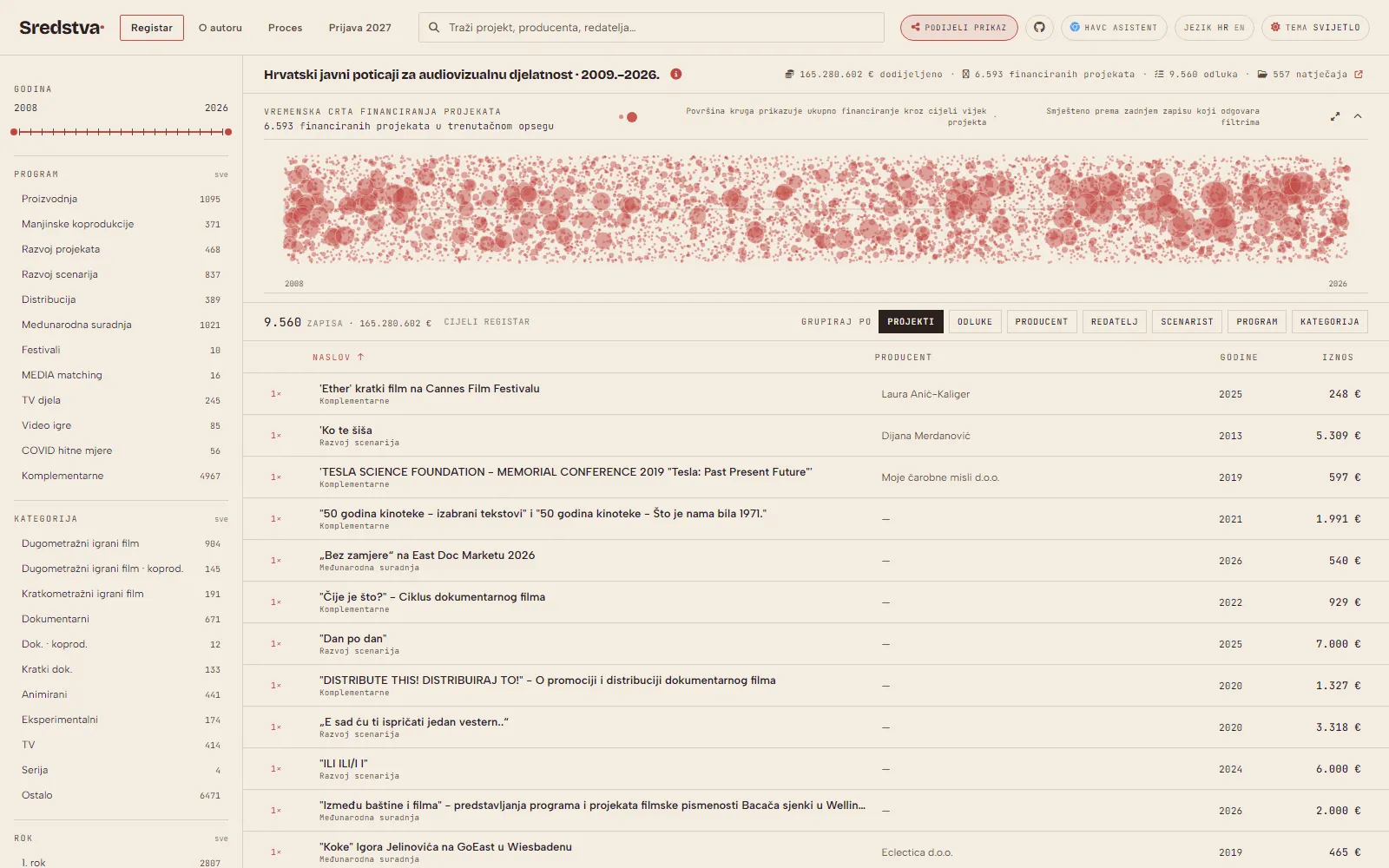
What followed was curation rather than invention. A final pass on 30 July 2026 stopped treating every extracted row as an award: deterministic rules and a structured model review reduced 12,845 raw rows to 9,543 verified result rows with one explicit non-award, and linked annual editions into stable project families. Kuna-era amounts are converted at the fixed 7.53450 rate with the original value kept, and the registry's yearly totals are cross-checked against HAVC's own published annual tables, with the deviations published rather than hidden. By the August edition the registry held 1,021 documents, 9,561 rows and 6,593 linked-project groups; the live ledger totals 165.3 million euros across 9,560 decisions and 557 calls, and the analytics studio shows what the PDFs never could — twenty recipients account for half of all attributable funding.
The product is deliberately plain: vanilla HTML, CSS and JavaScript with no framework or bundler, a 6,278-line main file that boots from a 5 MiB projection while the 17 MiB registry stays published unchanged. It runs on Cloudflare Workers, with D1 and a Durable Object behind a cookieless usage beacon and an owner-only statistics page locked behind Cloudflare Access. Two rules are enforced in code: a convenient interface must never sever a number from its source, and the registry must never carry third parties' personal data — auxiliary documents such as supplier-payment reports ship without their text, identifiers are masked everywhere else, and a test fails if any OIB, e-mail or phone number gets back in. The code is EUPL-1.2, the schema and structured data CC BY 4.0, and HAVC's reproduced full text is explicitly carved out of that grant.
Sredstva is not affiliated with HAVC and says so. Its stated win condition is to become unnecessary: if an official, open, continuously maintained dataset one day replaces it, the goal is met. On 7 September 2026 Aning Film applied to HAVC's complementary-activities call for 2027 with a 12,000-euro programme, 7,500 of it requested from the Centre — twelve monthly editions, at least thirty texts, a schema and field dictionary, a browser-based validation and conversion tool, a guide, and a consolidated dataset offered for the national open-data portal. The decision is pending. A companion Chrome extension, HAVC Companion, gives HAVC's own public-calls pages document labels, filters and in-place previews without changing their content, and is listed on the Chrome Web Store.
Milestones
- 2026-01-21 — First deterministic extraction scripts run over the HAVC PDF archive
- 2026-05-16 — Subagent fleet extracts the full corpus in a 48-hour sprint
- 2026-05-17 — Public launch: live registry, full dataset and open repository
- 2026-05-23 — Cross-check against HAVC's published annual totals added
- 2026-07-09 — HAVC Companion browser extension packaged as version 0.2.0
- 2026-07-30 — Final curation: verified funding statuses and project families
- 2026-08-03 — Cookieless usage measurement on Cloudflare Workers and D1
- 2026-08-31 — August edition: 1,021 documents, 9,561 funding rows
- 2026-09-03 — Personal-data redaction pinned by test; EUPL and CC BY licences
- 2026-09-07 — 2027 programme application submitted to HAVC
Outcomes
- Registry size — 1,021 source documents, 9,561 funding rows and 6,593 linked-project groups in the August 2026 edition.
- Live ledger — 165.3 million euros across 9,560 verified decisions and 557 calls, each linked to its source PDF.
- Open code and data — EUPL-1.2 code and CC BY 4.0 structured data on GitHub, 80 commits since the 17 May 2026 launch.
- Privacy by code — Auxiliary documents ship without text and a test blocks any OIB, e-mail address or phone number from the dataset.
- 2027 application — EUR 7,500 requested of a EUR 12,000 programme: twelve editions, thirty texts, a schema and an open-data tool; decision pending.
- Companion extension — HAVC Companion 0.2.0 listed on the Chrome Web Store, upgrading HAVC's own public-calls pages in place.
Credits
- Matija Radeljak — Author, editor and developer
- Aning Film d.o.o. — Publisher, rights holder and applicant
- Cloudflare — Workers, D1, Durable Objects and Access
- GitHub — Public repository
- Anthropic (Claude) and OpenAI (Codex) — Extraction and audit models in the data pipeline
- Hrvatski audiovizualni centar (HAVC) — Publisher of the source documents; not affiliated
Press & links
- https://havc.matijar.info
- https://havc.matijar.info/havc/data.json
- https://github.com/matijarma/havc-explorer
- https://chromewebstore.google.com/detail/havc-companion-%E2%80%94-javni-po/jjfmjbmebnljefefcgfdjljenilgmfpg
- https://havc.matijar.info/extension-privacy/
- https://havc.hr/o-nama/javni-pozivi