The Violinist
2010 · author-led urban narrative and participatory media initiative · short experimental film project expanded into a cross-media platform concept
Experimental Zagreb film project that expanded into a participatory cross-media urban platform.
Notes from the producer
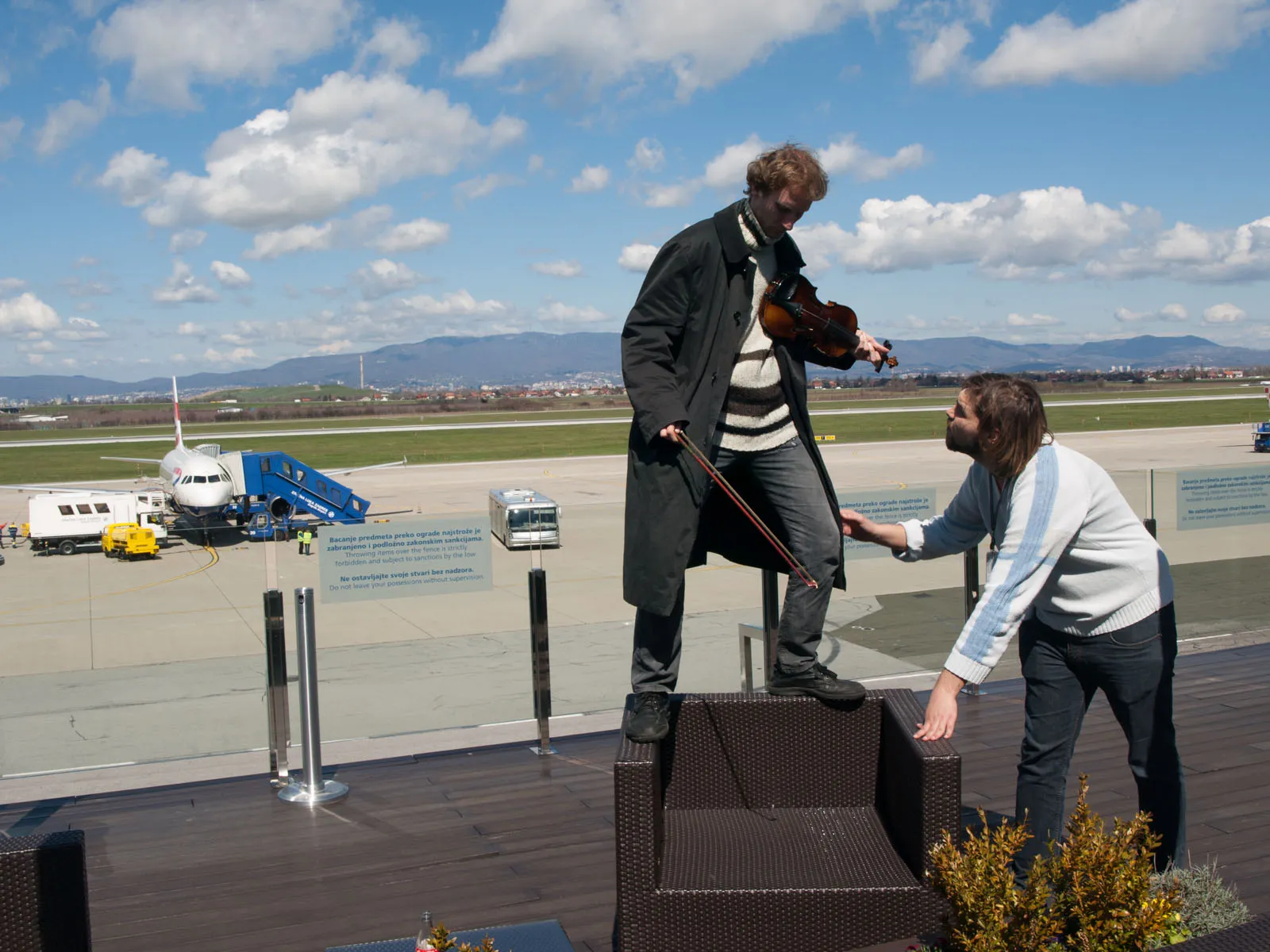
The Violinist is the project where I learned how far a single character can be pushed as a production tool. It started in 2010 as a small, stubborn idea that I kept refusing to let stay small. In early 2013 we had a real shoot - a third-draft script, call sheets, an actor (Mladen Vujcic), music by Matej Emer and Filip Gasparovic, and enough nerve to ask Zagreb Airport, Lisinski, the Zoo and Croatia Airlines to let a violinist loose in their spaces. Most of them said yes, which taught me more about producing than any film school would have.
Then I tried to turn a short film into a platform. With Neuralab (Digitalni oblak) we signed a co-production in April 2014 and drew up a version of the project - Potraga za Violinistom - where the whole city could pin money and memories to a map. On paper the budget went from about 122.000 to over 600.000 kuna. In practice the platform never fully shipped, and I never produced a clean final account of what was spent against what was planned. I won't dress that up: the film-era work happened, the participatory machine mostly stayed a very well-argued plan.
What I keep from it is the method - using one character as a key to real institutions and real collaborators. That part worked, and it's the part I still use.
- Matija Radeljak
The story
The Violinist began in 2010 as an experimental short film. A scenario dated 14 June 2010 already fixed the central figure: a street musician built to work as a mirror for Zagreb - its fears, contradictions, and stubborn everyday resilience. Mladen Vujcic played him, and the music that motivates the character was written by Matej Emer and Filip Gasparovic.
By late January 2013 the screenplay had reached its third revision, and within weeks the project was on its feet - shooting schedules, daily call sheets, and a media release dated 4 February 2013. Rather than build sets, Radeljak wired the film into the city's own infrastructure, negotiating access with Zagreb Airport (Zracna luka Zagreb), the Vatroslav Lisinski concert hall, the Zagreb Zoo, and Croatia Airlines.
Through 2014 the short refused to stay a short. Under the title Potraga za Violinistom (In Search of the Violinist), the team reconfigured it as a participatory cross-media platform - a crowdfunding map of Zagreb where residents could pin money and memories to specific squares and streets, turning viewers into co-authors. That shift was formalized in a co-production agreement between Aning usluge d.o.o. and Digitalni oblak d.o.o. (Neuralab), signed on 9 April 2014 with Kresimir Koncic on the partner side, alongside a dated operational plan.
The economics record the ambition plainly. The early film package was budgeted at roughly 121.931,25 HRK; the consolidated plan dated 13 June 2014 restructured the project into a 611.745,75 HRK ecosystem, splitting development (172.000), production (130.000), and promotion and distribution (123.000) into separate lines, with a Croatian Audiovisual Centre (HAVC) support track referenced in the correspondence.
What the archive documents thoroughly is intent and structure; what it does not is a clean ending. The film-era work - script, shoot, press, partnerships - was carried out; the expanded platform was never fully delivered, and no final reconciliation of realized spend against the planned totals survives. As a portfolio entry the project reads less as a finished object than as a proof of method: how a single authored character can be used to negotiate real access to a city's institutions, and how service and co-production can scaffold an artwork toward something closer to public infrastructure.
Milestones
- 2010-06 — Earliest authored scenario dates the core short-film concept
- 2013-01 — Third screenplay revision formalizes the short film structure
- 2013-02-04 — Public media release announces the project in Zagreb
- 2013-02 — Multi-day shooting executed across Zagreb locations
- 2013-03 — Partner outreach to Croatia Airlines, KD Lisinski and Zagreb Zoo
- 2014-04-09 — Signed AF-Neuralab co-production agreement and operational plan
- 2014-06-13 — Consolidated 611.745,75 HRK financial plan for the expanded platform
Outcomes
- Media release issued — Dated public media release for the Violinist in Zagreb on 4 February 2013.
- Shoot executed — Production scheduling and daily call sheets confirm multi-day shooting operations in 2013.
- Co-production signed — Formal co-production agreement between Aning usluge d.o.o. and Digitalni oblak d.o.o. signed on 9 April 2014.
- Scope expanded to platform — Project moved from a single short-film package toward a multi-format participatory city platform (Potraga za Violinistom).
- Platform not closed — Final implementation of the expanded platform and a reconciliation of realized spend versus planned HRK totals remain undocumented.
Credits
- Matija Radeljak — Author, producer, director
- Mladen Vujcic — Lead actor (the Violinist)
- Matej Emer — Music co-author and screenplay co-author
- Filip Gasparovic — Music co-author
- Bojan Kanjera — Producer
- Kresimir Koncic — Co-production partner representative (Neuralab)
- Aning usluge d.o.o. — Production company
- Digitalni oblak d.o.o. (Neuralab) — Co-production partner
Press & links
- Violinist - a Zagreb city quest by the Aning Film production team (Secret Zagreb)
- Violinist - multiplatformska zagrebacka rapsodija (Plan B)
- https://secret-zagreb.com/2013/05/10/violinist/
- https://planb.hr/tag/matija-radeljak/
- https://planb.hr/tag/bojan-kanjera/
- https://planb.hr/staging/violinist-multiplatformska-zagrebacka-rapsodija/
- https://havc.hr/eng/croatian-film/croatian-film-catalogue/one
- https://www.behance.net/AningFIlm
- https://havc.hr/eng/croatian-film/croatian-film-catalogue/fragments
- http://www.zagreb-touristinfo.hr/?id=204&l=h
- http://www.youtube.com/watch?v=_crnol1u8fq